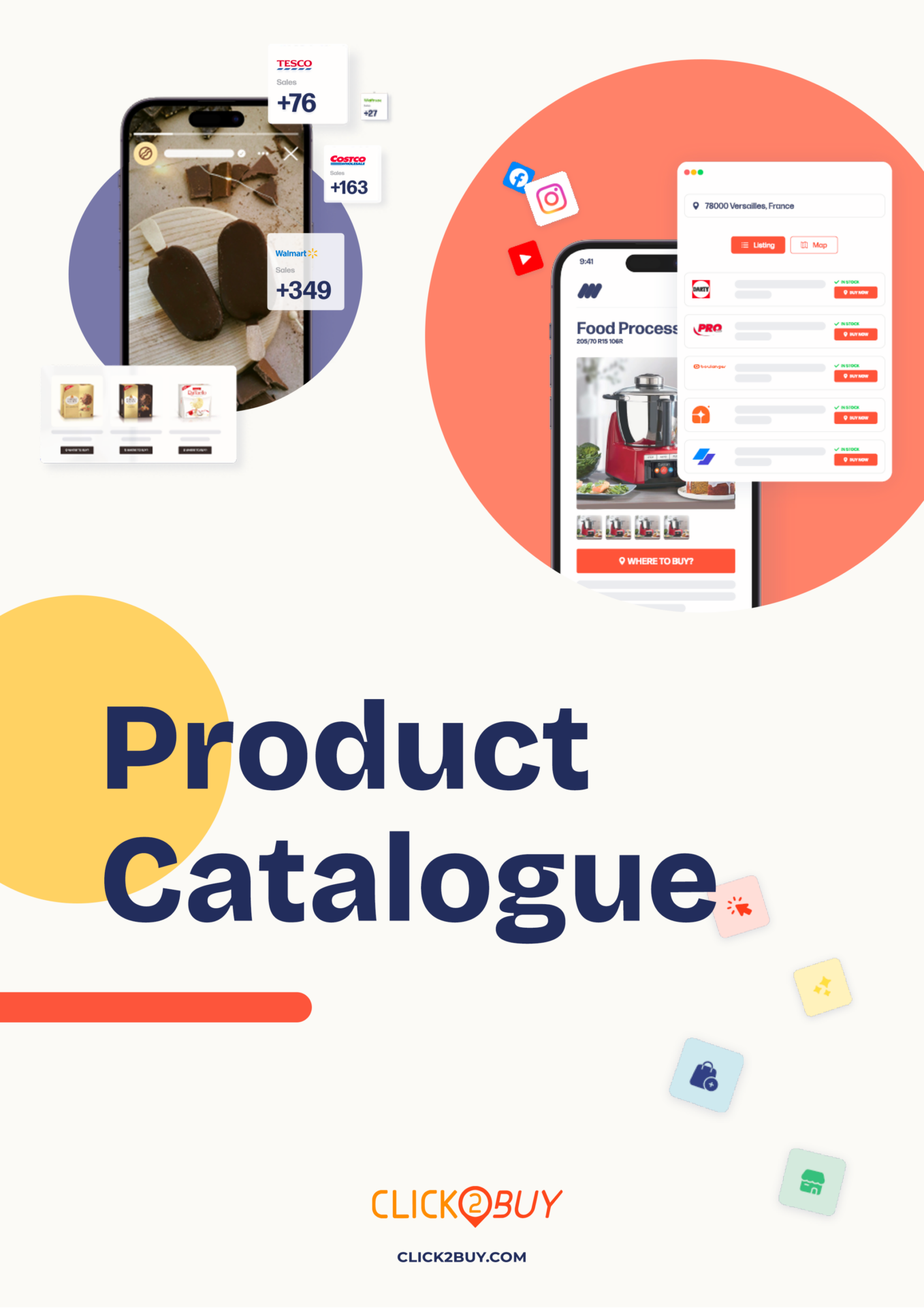
A display banner that sends users to a generic page does not do much. It generates a click. Sometimes a bit of traffic. Not necessarily a sale. Shoppable media starts from a simple idea: reducing the distance between exposure and purchase. A good banner should not only catch attention. It should guide the user toward a useful action. Otherwise, you remain in a classic visibility model, not in a business lever.
Good practice
Make the banner land on a concrete buying journey: a product, a retailer, availability, or a credible alternative in case of out-of-stock.
What to avoid
Sending the user to the brand website homepage and then leaving them to do all the work. This is exactly where conversion breaks.
On the ground, the problem is always the same. Media teams buy reach. Marketing teams look at clicks. Sales teams want to know whether the campaign really moved someone closer to purchase. Between the three, there is often a gap. The banner works visually. The click happens. Then nothing is really readable. This is where shoppable media becomes interesting. Not because it is more modern. Because it shortens the path between the message and the point of sale.
Why most banners stop too early
The problem is not display itself. The problem is what teams ask it to do. Many campaigns stop at the click. But a click is not worth much if it leads to a page that is too broad, too cold, or disconnected from the creative promise. An interactive display ad only makes sense if it helps the user take the next step without unnecessary friction.
In most cases, the blocker is very concrete. The banner promotes a product. The user clicks. Then they land on a page mixing several ranges, several messages and sometimes several CTAs. They have to find where to buy by themselves. They have to understand which distributor to choose. They have to check whether the product is available. In other words, the banner-to-point-of-sale journey has not really become an instant point of sale. It has only moved the problem further away.
This is why a purchase-oriented display campaign must be designed as the start of a transaction. Not as a nicely packaged exposure moment. If you want to understand how this kind of setup works, you need to look at how the retailer exit is structured, not only how the banner is designed.
What a shoppable banner really needs to do
A good shoppable banner does not try to tell everything. It tries to remove a detour. The user should understand the product, feel the interest, then land on a credible buying option. This is the logic that makes it possible to turn a banner into a purchase, or at least into measurable purchase intent.
- Highlight a clearly identified product or offer
- Send the user to a relevant retailer or buying module
- Take product availability into account at the moment of the click
- Plan a useful redirection if the product cannot be found
- Measure retailer exits, not only CTR
In other words, a clickable banner toward retailers only has value if the journey behind it holds up. Otherwise, you are doing classic display with a commerce layer on top. It looks good in a presentation. It is much less convincing in the numbers.
Why performance often gets stuck
Because teams still look at the wrong signals. A good click-through rate can hide poor execution. A banner can generate traffic very well and sell very poorly. Conversely, a campaign with fewer clicks that guides users toward the right distributors can generate stronger purchase intent.
Let us be direct: display that simply pushes users to the brand website without a useful conversion logic does not work very well for indirect distribution. It is not close enough to the act of purchase. A brand selling through retailers must treat digital advertising toward distributors as a bridge, not as a showcase. Otherwise, it measures curiosity, not demand.
This reading becomes much stronger when you track what happens after the click. Not only traffic. Retailer exits. Products viewed. Distributors chosen. Channels that really trigger action. These signals are often what classic display reporting is missing.
| Situation | What blocks performance | What to do |
|---|---|---|
| The banner generates clicks but little action | Landing page too broad or without a clear next step | Send users to a relevant product or retailer selection |
| Traffic arrives but conversion does not follow | No visible stock or poor distributor selection | Connect media message, availability and point of sale |
| The campaign looks good in media dashboards | KPIs stop too early | Measure retailer exits and real intent |
| The journey looks clean but drops quickly | Too many steps between exposure and purchase | Remove unnecessary intermediary pages |
The hidden topic behind shoppable media
Teams often talk about creative, format, click and interactivity. In reality, the real topic is often data. If you do not know which distributors are available, which products perform, which price gaps exist or which references are out of stock, your shoppable banner is built on nothing. It can be very well designed and still send users toward a poor experience.
This is why retailer data quality matters as much as the banner itself. If you redirect users to a distributor that does not have the product, or to a page that does not match the initial promise, you break the momentum created by the media. This point is not only technical. It directly affects performance.
What we recommend in practice
For a brand selling through indirect distribution, the right reflex is not to make the banner more engaging. The right reflex is to make it more useful. A banner must lead to a credible instant point of sale. Online or physical. Direct or assisted. It does not matter. What matters is that the consumer immediately understands where to go to buy.
In this context, Click2Buy is mainly a concrete example. Display, social, newsletters or brand pages are no longer simple touchpoints. They become measurable levers toward retail partners. The brand sees where traffic goes, which products generate the most interest, which distributors perform and which channels actually trigger a useful exit. At that point, this is no longer a visibility logic. It is a logic of performance, conversion and indirect sales.
So yes, shoppable media can turn a display banner into an instant point of sale. But not with a magic button. It requires a clean journey, reliable data, a relevant retailer and a business reading after the click. Everything else is display hoping to do more than it really can.
Why does shoppable media change display banner performance?
Because it reduces the distance between the advertising message and purchase.
How can a display banner become an instant point of sale?
By adding a direct exit toward the right distributor or the right point of sale.
How much friction can a shoppable banner remove?
Often a lot, because the user moves faster from interest to action.
14 reviews

Maxence Antao, Communications Officer at Click2Buy
Our role at Click2Buy is to guide our clients throughout the buying journey and optimize their marketing ROI using real-time retailer stock data.